
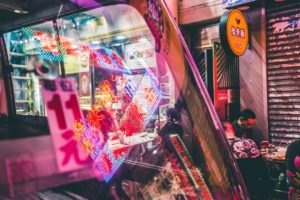
 Pachinko is one answer to Japanese people’s quest for games and the thrill of winning in a country where gambling is mostly banned apart from a few forms such as horse racing and motorsports.
In Pachinko you exchange money for steel balls (11mm in diameter) which you feed into the Pachinko machine. It can be best described as a vertical pinball machine. Modern electronics have adapted the game into a noisy gaming and entertainment experience. After the second world war the game found it’s biggest rise. Surprisingly the origins of the game were in the USA but today’s machines have little in common other than the pins and balls.
Social Pachinko
It does give many people a problem of addiction and social views are split. Yet still the government turn a blind eye currently to the game.
In Japan you can find dedicated Pachinko parlours where you can exchange any ‘winnings’ for a ticket and a loophole for getting winnings is that you must exchange this ticket for money in a different building.
In Japan you can find dedicated Pachinko parlours where you can exchange any ‘winnings’ for a ticket and a loophole for getting winnings is that you must exchange this ticket for money in a different building.
With the variations of the game being so widespread it is impossible to really understand the odds of winning. Part of this is down to the law of gambling so odds would not be made public either. You play for the entertainment value. It’s highly unlikely you would find professional gamblers in Japan let alone in a Pachinko parlour. But no casino can afford to run at a loss and the same is true of the Pachinko parlour. One Youtube video states the odds of Amusement Pachinko being 1/10 and Real Pachinko being 1/350.
A spin off and modern trend is to play a more relaxing version in coffee shops which prevent smoking and the sheer volume of machines. You can only win prizes such as coffee or sake or other goods to enjoy on the premises after a 30 minute Pachinko session.
A spin off and modern trend is to play a more relaxing version in coffee shops which prevent smoking and the sheer volume of machines. You can only win prizes such as coffee or sake or other goods to enjoy on the premises after a 30 minute Pachinko session.
Pachinko is one answer to Japanese people’s quest for games and the thrill of winning in a country where gambling is mostly banned apart from a few forms such as horse racing and motorsports.
In Pachinko you exchange money for steel balls (11mm in diameter) which you feed into the Pachinko machine. It can be best described as a vertical pinball machine. Modern electronics have adapted the game into a noisy gaming and entertainment experience. After the second world war the game found it’s biggest rise. Surprisingly the origins of the game were in the USA but today’s machines have little in common other than the pins and balls.
Social Pachinko
It does give many people a problem of addiction and social views are split. Yet still the government turn a blind eye currently to the game.
In Japan you can find dedicated Pachinko parlours where you can exchange any ‘winnings’ for a ticket and a loophole for getting winnings is that you must exchange this ticket for money in a different building.
In Japan you can find dedicated Pachinko parlours where you can exchange any ‘winnings’ for a ticket and a loophole for getting winnings is that you must exchange this ticket for money in a different building.
With the variations of the game being so widespread it is impossible to really understand the odds of winning. Part of this is down to the law of gambling so odds would not be made public either. You play for the entertainment value. It’s highly unlikely you would find professional gamblers in Japan let alone in a Pachinko parlour. But no casino can afford to run at a loss and the same is true of the Pachinko parlour. One Youtube video states the odds of Amusement Pachinko being 1/10 and Real Pachinko being 1/350.
A spin off and modern trend is to play a more relaxing version in coffee shops which prevent smoking and the sheer volume of machines. You can only win prizes such as coffee or sake or other goods to enjoy on the premises after a 30 minute Pachinko session.
A spin off and modern trend is to play a more relaxing version in coffee shops which prevent smoking and the sheer volume of machines. You can only win prizes such as coffee or sake or other goods to enjoy on the premises after a 30 minute Pachinko session.
Recent Comments